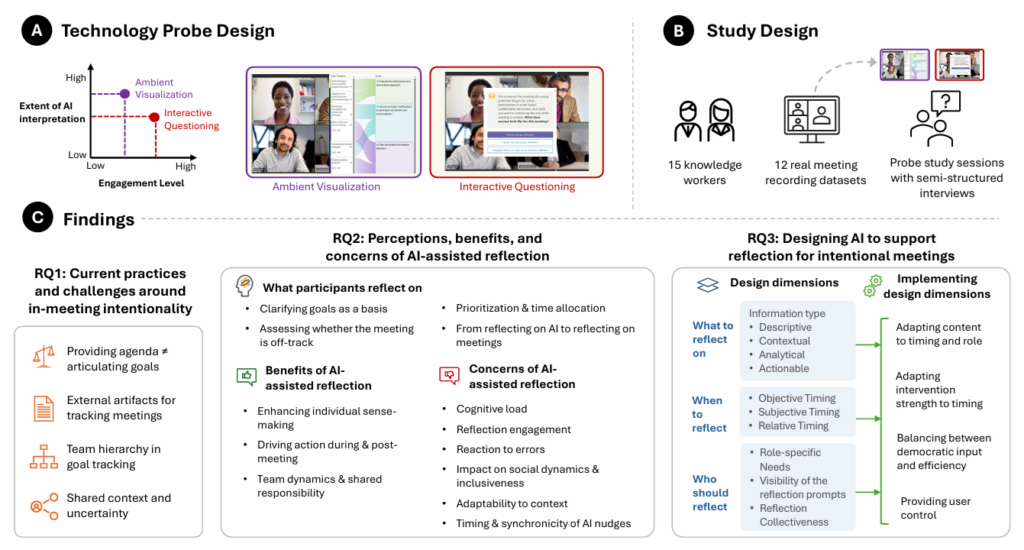
Meetings often suffer from a lack of intentionality, such as unclear goals and straying off-topic. Identifying goals and maintaining their clarity throughout a meeting is challenging, as discussions and uncertainties evolve. Yet meeting technologies predominantly fail to support meeting intentionality. AI-assisted reflection is a promising approach. To explore this, we conducted a technology probe study with 15 knowledge workers, integrating their real meeting data into two AI-assisted reflection probes: a passive and active design. Participants identified goal clarification as a foundational aspect of reflection. Goal clarity enabled people to assess when their meetings were off-track and reprioritize accordingly. Passive AI intervention helped participants maintain focus through non-intrusive feedback, while active AI intervention, though effective at triggering immediate reflection and action, risked disrupting the conversation flow. We identify three key design dimensions for AI-assisted reflection systems, and provide insights into design trade-offs, emphasizing the need to adapt intervention intensity and timing, balance democratic input with efficiency, and offer user control to foster intentional, goal-oriented behavior during meetings and beyond. KEYWORDS: videoconferencing, meeting, goal, intentionality, generative AI, probe, active, passive, intervention, interruption
@inproceedings{chen2025are,
author = {Chen, Xinyue and Tankelevitch, Lev and Vanukuru, Rishi and Scott, Ava Elizabeth and Panda, Payod and Rintel, Sean},
title = {Are We On Track? AI-Assisted Active and Passive Goal Reflection During Meetings},
booktitle = {CHI 2025},
year = {2025},
month = {April},
publisher = {ACM},
url = {https://www.microsoft.com/en-us/research/publication/are-we-on-track-ai-assisted-active-and-passive-goal-reflection-during-meetings/},
}